What Actually Happens When a Pro Shows Up to Handle Mold
If you've noticed that musty smell or spotted dark spots creeping along a wall, you've probably already Googled "how to remove mold" at least once. And you've probably found a lot of conflicting advice — bleach it, scrub it, seal it, ignore it.
Here's the thing: the reason mold keeps coming back for most homeowners is that surface cleaning isn't mold remediation. They're not the same thing. Professional mold removal in Wichita, KS follows a specific process built around containment, elimination, and prevention — not just making the visible stuff disappear.
Here's what the pros actually do.
Step 1: Inspection and Moisture Source Identification
Before anything gets cleaned, a professional finds out why mold is there. Mold doesn't just show up — it follows moisture. Whether it's a slow pipe leak behind drywall, high humidity in a crawl space, or water intrusion after a storm, the source has to be identified and addressed or the mold will return no matter how thorough the cleanup.
Pros use moisture meters, thermal imaging cameras, and air quality testing to map both visible and hidden growth. This step alone is something most DIY approaches skip entirely — and it's usually why the mold comes back.
Step 2: Containment
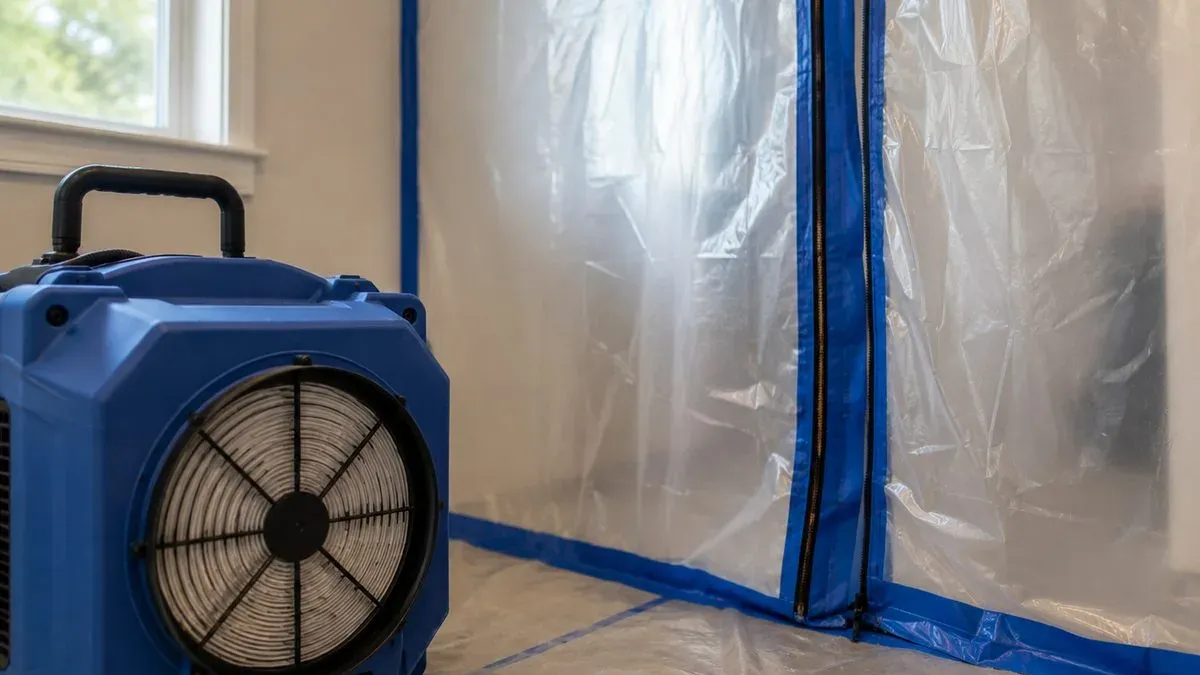
Once the scope is understood, the affected area gets sealed off. This means plastic sheeting over doorways, negative air pressure systems, and controlled access. The goal is to keep mold spores from traveling to unaffected parts of the home during the removal process.
This is especially important in Wichita homes where HVAC systems can quickly spread airborne spores throughout the house if the work area isn't properly isolated.
Step 3: HEPA Air Filtration and Scrubbing
Industrial HEPA air scrubbers run continuously during remediation. These machines pull airborne mold spores out of the environment at a rate that standard household air purifiers simply can't match — HEPA filtration captures particles as small as 0.3 microns, which covers virtually all mold spore types.
This step is running the whole time remediation is underway, not just at the end.
Step 4: Physical Removal and Treatment
Here's where technique matters most. Depending on the material affected:
- Porous materials (drywall, insulation, carpet, wood studs): these are typically removed and disposed of entirely. Mold penetrates deep into porous surfaces, and no amount of surface treatment eliminates it safely.
- Semi-porous materials (unfinished wood, concrete): HEPA vacuuming followed by wire brushing and antimicrobial treatment.
- Non-porous materials (tile, metal, glass): cleaning and disinfection is usually sufficient.
Antimicrobial and antifungal agents applied after removal are EPA-registered products — not household bleach, which is ineffective on porous surfaces and doesn't address the root biology of mold growth.
Step 5: Encapsulation (When Appropriate)
In some situations — particularly with structural wood that can't be fully replaced — encapsulation is used after cleaning. This is a specialized sealant that locks in any remaining microscopic traces and prevents regrowth. It's not a shortcut; it's a final layer of protection applied after proper removal.
Step 6: Post-Remediation Verification
Legitimate mold remediation doesn't end when the crew packs up. Air quality testing after the job confirms spore counts are back within normal levels before the area is cleared for re-occupancy. This is the step that separates a real remediation company from a guy with a spray bottle.
Why This Matters for Wichita Homeowners
Kansas humidity, older housing stock, and severe weather events — including flooding and ice dam leaks — make mold a real and recurring issue in the Wichita area. Whether you're dealing with water damage in Wichita that wasn't dried properly, a basement that's been damp for years, or visible growth in a bathroom or crawl space, the process above is what actually resolves it.
If you're in the greater Wichita area and you've found mold in your home, don't waste time or money on temporary fixes. Our mold removal team has been handling remediation for Kansas homeowners since 2012, and we'll tell you exactly what you're dealing with before any work begins.
Call Good To Be Clean at (316) 320-6767 — we're available 24/7, and the first step is just a conversation.